Cats · Product picks
The Best Cat Brushes
The FURminator Undercoat deShedding Tool is our top pick. See four researched cat brushes and combs, plus how to match one to your cat’s coat.
We may earn a commission if you buy through links on this page. It never decides what we pick.How that works
The best cat brush depends on your cat’s coat. For heavy shedders, our top pick is the FURminator Undercoat deShedding Tool. For short coats or shy cats, try a soft rubber brush. For long coats, pair a slicker brush with a steel comb.
Our picks at a glance
- Best overall: FURminator Undercoat deShedding Tool for Cats
- Best for cats who dislike brushes: KONG Cat ZoomGroom
- Best slicker brush: JW Gripsoft Slicker Brush for Cats
- Best comb: Andis 7-1/2” Steel Comb
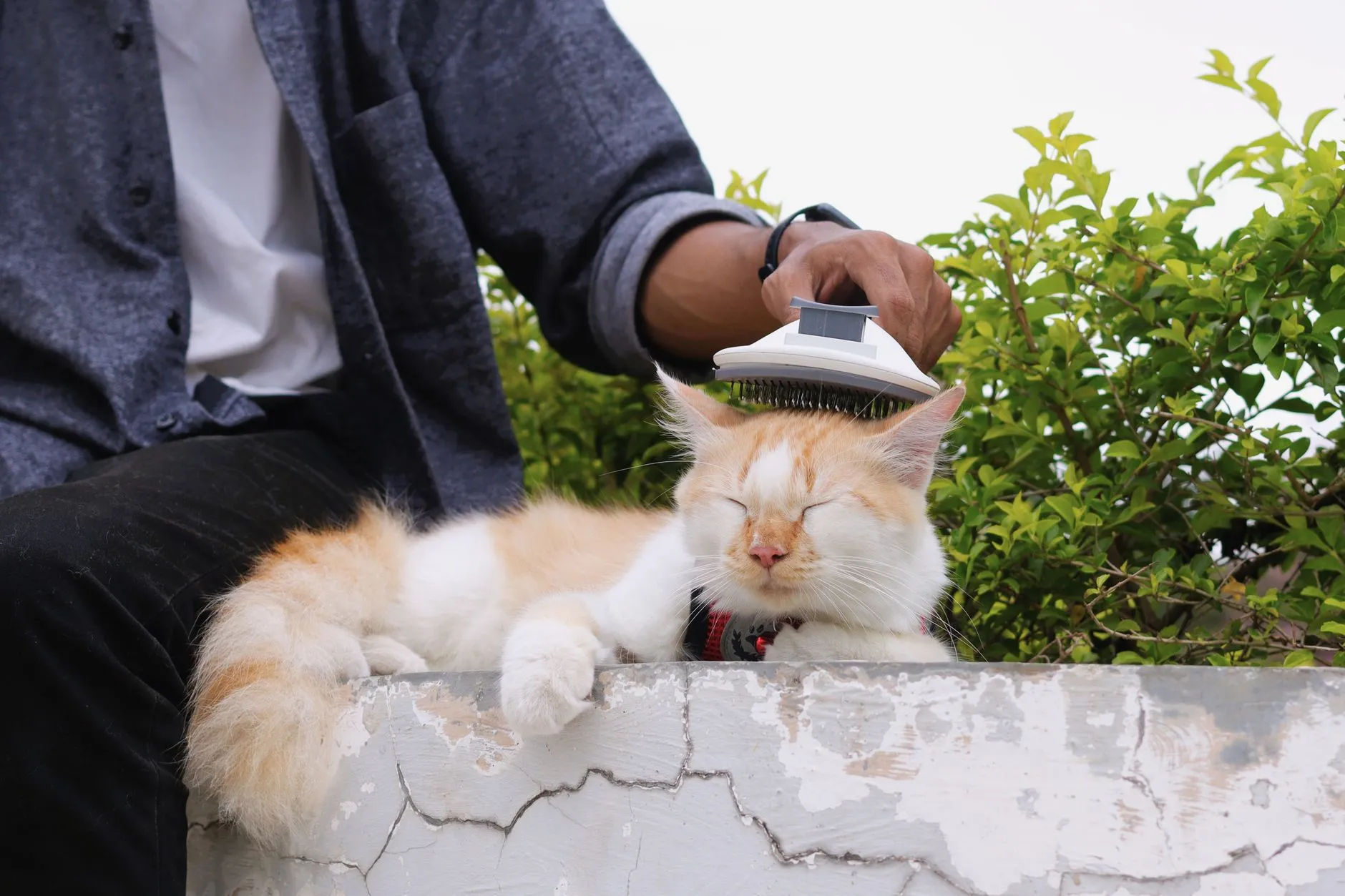
The best cat brushes
Cat brushes
FURminator Undercoat deShedding Tool for Cats
Best for: Heavy shedders with thick undercoats
The maker says its stainless steel edge reaches through the topcoat to remove loose hair and undercoat. This version is for long-haired cats over 10 pounds. FURminator also makes small and short-hair versions. Skip it for matted fur, because the maker warns that mats can bend or break the teeth. It also says not to use it on non-shedding breeds or cats with sensitive skin.
- Pro: Stainless steel edge reaches through the topcoat to remove loose hair and undercoat
- Pro: Skin guard with a curved edge and a button that releases hair
- Pro: Also made in versions for small cats and short-haired cats
- Con: Not for matted fur, because mats can bend or break the teeth
- Con: The maker says not to use it on non-shedding breeds or cats with sensitive skin
Cat brushes
KONG Cat ZoomGroom
Best for: Cats who are new to brushing or touchy about it
This soft rubber brush is made of TPE and works on all coat types, says KONG. You brush in gentle circles to lift loose hair. It is a good first brush for a cat who isn’t used to being groomed. Skip it if your cat has tangles or mats, since rubber won’t work them out.
- Pro: Made of soft, flexible TPE rubber
- Pro: Works on all coat types, says the maker
- Pro: Can also be used with shampoo at bath time
- Con: Won't work out tangles or mats
- Con: One size only
Cat brushes
JW Gripsoft Slicker Brush for Cats
Best for: Cats with medium or long coats, or thick double coats
Its metal pins come in two lengths. They lift loose undercoat and loosen light mats, and they are angled away from the skin. Petmate says it suits short, medium and long coats, and thick double coats. Skip it if your cat hates pins on the skin. Use light strokes.
- Pro: Metal pins in two lengths lift loose undercoat and loosen light mats
- Pro: Pins are angled away from the skin
- Pro: Rubber-sheathed handle gives a non-slip grip
- Con: Pins can still pull on mats, so go slowly
- Con: Ships in assorted colors, so you can't pick one
Cat brushes
Andis 7-1/2" Steel Comb
Best for: Long-haired cats and checking for tangles
This steel comb has coarse and fine teeth, so you can work through tangles and then smooth the coat. At 7.5 inches it is easy to hold. Andis sells it as a professional groomer tool. Skip it if you want one tool to remove lots of shed hair, because a comb is for detangling and finishing.
- Pro: Steel teeth with a coarse and a fine section
- Pro: Small 7.5-inch size is easy to control
- Pro: Very light, at 0.2 ounces
- Con: Sold as a professional groomer tool, so it has no soft grip
- Con: Does not remove loose undercoat as fast as a deshedding tool
How to choose a cat brush
Match the tool to the coat
Most cats have a smooth outer coat over a soft undercoat, according to the sources we read. Long-haired cats often have fine, silky coats that tangle easily. Petmate suggests these starting points:
- Short coats: a bristle brush, once or twice a week.
- Long coats: a slicker brush, with a wide-toothed comb first to loosen tangles. Brush daily.
- Curly coats: a grooming glove.
Cornell Feline Health Center suggests getting your cat used to daily brushing and combing to help prevent hairballs. The ASPCA says frequent brushing reduces shedding and hairballs too.
Think about your cat’s comfort
Some cats like pins and teeth. Others don’t. A soft rubber brush is a gentle way to start. Move to a slicker or comb once your cat is relaxed. Short sessions are better than a long one that ends in a fight.
Check the size and the fit
Some tools come in sizes. The FURminator cat tool, for example, comes in versions by cat size and coat length. Pick the one that matches your cat’s weight and hair. Choose a handle you can hold comfortably, such as a rubber grip.
Safety tips
- Check the skin first. FURminator says to look for sores, bruises and skin problems before brushing. If you see any, see your vet first.
- Go easy near sensitive spots. FURminator says to take extra care around the stomach, legs and rear end.
- Use light pressure. FURminator says rough brushing can irritate skin, and to stop if you see redness.
- Handle mats gently. Petmate says to hold the base of the mat and detangle slowly. Don’t use scissors. For severe mats, ask a professional groomer or your vet.
- Look over the tool. KONG says to stop using a toy-style product if it is damaged, and to call a vet if a piece is swallowed. The same sense applies to any brush that cracks or loses parts.
- Skip human products. Petmate advises against human shampoos or harsh products on cats.
Common questions
How often should I brush my cat?
It depends on the coat. Cornell Feline Health Center suggests getting your cat used to daily brushing and combing to help with hairballs. Short-haired cats may need it less often, and long-haired cats do best with brushing every day.
What is the best brush for a short-haired cat?
Petmate suggests a bristle brush for short coats, once or twice a week. A soft rubber brush like the KONG Cat ZoomGroom is another gentle choice for loose hair.
What should I do about mats in my cat’s fur?
Tease small mats apart gently with your fingers and a comb, working from the skin outward. Don’t cut them with scissors, because it is easy to cut the skin. For bad mats, ask a groomer or your vet.
Does brushing help with hairballs?
Yes. The ASPCA says frequent brushing keeps the coat clean, reduces shedding and cuts down on hairballs.